Posted by Lynn | Certified Health Coach and educator | 8-minute read
| Quick answer: In 2021, California’s OEHHA concluded that synthetic dyes can cause hyperactivity and other behavior problems in some children, and the American Academy of Pediatrics says they may worsen ADHD symptoms. The FDA says it has not established a causal link. Scientists agree on this much: more research is needed. |
Key takeaways
- Red No. 3 is being revoked because of cancer in lab rats, not because of behavior research.
- The behavior question is separate. Some children appear more sensitive to dyes than others.
- Federal dye phase-outs announced in 2025 are largely voluntary, so the label is still your best tool.
Your child’s cereal is a shade of red that doesn’t exist in nature. Is that a problem, or just a color? The honest answer on artificial food dyes and kids is that scientists, regulators, and pediatricians don’t fully agree, so let’s lay out what each side actually says.
I’ll give you the findings, the limits, and what’s still unsettled, so you can make the call for your own family.
Where I’m Coming From
I’ve spent more than five years leading health classes in community churches, and I know families want something they can use, not something that scares them. I take that seriously. I’m also an educator, not a physician, so what follows reflects the research, not medical advice for your child.
Have you ever dropped a child off to a birthday party? That excited, engaged child may not be the one you pick up. The child returning home with you may be completely different. If your child has food color & sugar sensitivity, prepare for the ride home. You may experience screaming, crying, combative, and uncontrollable behavior that wasn’t present before.
Two Different Questions About Artificial Food Dyes and Kids
When people talk about artificial food dyes and kids, two separate stories get tangled together. One is about cancer risk: that is why the FDA moved against Red No. 3. The other is about behavior and attention: that is where the parent worry usually lives. They rest on different studies and different evidence. If you hear someone blend them into one scary headline, that’s your cue to slow down.
What the Behavior Research Says
In April 2021, the California Office of Environmental Health Hazard Assessment (OEHHA), the state’s science agency for health risks, reviewed the evidence on synthetic food dyes. It concluded that synthetic food dyes “can result in hyperactivity and other neurobehavioral problems in some children,” and that children vary in sensitivity. OEHHA also noted that the FDA’s acceptable daily intake limits rest on studies that are 35 to 70 years old, and that juice and soft drinks are among the main sources of dye exposure (OEHHA press release, April 16, 2021).
The American Academy of Pediatrics (AAP) took a careful position in its 2018 policy statement, “Food Additives and Child Health.” It said that artificial food colors “may be associated with worsened ADHD symptoms,” and it advised families to favor fresh or frozen fruits and vegetables over processed foods (AAP, July 23, 2018). Notice the words: “may be associated.”
Some reviews also say the data is thin. A 2022 review of blue dyes in the journal Cureus found only four studies that met its criteria, called the literature “limited,” and concluded that more research is necessary (Kashyap, Cureus, September 16, 2022). So: real signals, real gaps.
What the FDA Says
The FDA takes a more cautious position. It points out that its 2011 Food Advisory Committee concluded that a causal link between color additives and hyperactivity in children “had not been established,” and that average exposure is below the acceptable daily intake. The agency also reviewed one study that found small-to-medium effects and said it did not recommend eliminating colors as a general treatment for ADHD (FDA review).
Here’s the bottom line on artificial food dyes and kids. Put the three side by side and you get a fair summary: California’s scientists and the pediatricians’ group see enough to be concerned. The FDA says the case isn’t proven. Nobody is saying the question is closed. I’d call that “accumulating,” not “proven.”
What Happened to Red No. 3
Red No. 3 (also called erythrosine) is the dye the FDA is actually revoking. The reason is a legal rule known as the Delaney Clause, which bars any food additive that has been found to cause cancer in people or animals. In this case, the FDA cited studies showing cancer in male laboratory rats through a hormonal mechanism. The agency says there is no evidence that it causes cancer in people (FDA, “FD&C Red No. 3”).
The FDA issued orders on this in January 2025. Food manufacturers have until January 15, 2027, to comply, and makers of ingested drugs until January 18, 2028. So you may still see Red No. 3 on some labels for a while.
The 2025 Phase-Out Plan: Mostly Voluntary
On April 22, 2025, HHS and the FDA announced a plan to revoke authorization for Citrus Red No. 2 and Orange B, and to work with industry to phase out six other petroleum-based dyes, Green No. 3, Red No. 40, Yellow No. 5, Yellow No. 6, Blue No. 1, and Blue No. 2, by the end of 2026 (FDA announcement).
Here’s the catch: most of that phase-out depends on companies choosing to do it. Trade press reported in September 2026 that the effort was still largely voluntary, with companies such as General Mills, Kraft Heinz, and Nestlé USA pledging changes, and Walmart pointing to a January 2027 timeline (Bakery&Snacks, September 1, 2026). Pledges aren’t the same as shelves. Until your cart looks different, the label is what counts. (Here’s how to read it: How to Read a Nutrition Label.)
So What Now? Your Do-This-Week Steps
Here’s what to do about artificial food dyes and kids without turning snack time into a courtroom.
- Scan for the names. On the ingredient list, look for “Red 40,” “Yellow 5,” “Yellow 6,” “Blue 1,” and “Red 3.”
- Check the drinks first. OEHHA named juice and soft drinks as major sources, so beverages may be the easiest swap.
- Add color the natural way. Fresh or frozen fruits and vegetables are the AAP’s simple suggestion.
- Talk to your pediatrician. If your child has ADHD or you’ve noticed a pattern, don’t change a treatment plan on your own. Bring your observations to the doctor.
- Skip the guilt. Dyes are in thousands of products. Nobody dodges all of them, and this isn’t about willpower. It’s about what’s put on the shelves (here’s the bigger picture).
Dyes are one piece of a bigger picture. If you want that context, start with What Is Ultra-Processed Food?
Frequently Asked Questions
Do artificial food dyes and kids’ hyperactivity go together?
California’s OEHHA concluded in 2021 that synthetic dyes can cause hyperactivity and other neurobehavioral problems in some children. The FDA says a causal link has not been established. Children vary in sensitivity, and researchers say more studies are needed.
Do food dyes make ADHD worse?
The American Academy of Pediatrics says artificial food colors may be associated with worsened ADHD symptoms. The FDA reviewed one study with small-to-medium effects and does not recommend eliminating colors as a general ADHD treatment. Talk to your child’s doctor before changing a treatment plan.
Why is Red No. 3 being banned?
The FDA is revoking Red No. 3 under the Delaney Clause because it caused cancer in male laboratory rats through a hormonal mechanism. The FDA says there is no evidence it causes cancer in humans. Food makers must comply by January 15, 2027.
Which food dyes is the FDA phasing out?
In April 2025, HHS and the FDA announced plans to revoke Citrus Red No. 2 and Orange B, and to work with industry to phase out Green No. 3, Red No. 40, Yellow No. 5, Yellow No. 6, Blue No. 1, and Blue No. 2 by the end of 2026. Most of the phase-out is voluntary.
How can I find artificial dyes on a food label?
Check the ingredient list for names such as Red 40, Yellow 5, Yellow 6, Blue 1, and Red 3. Beverages, cereals, candy, and snacks are common places to look.
This article is for educational purposes only and is not a substitute for medical advice. I’m an educator and health coach, not a physician. Your doctor, your child’s pediatrician, or a registered dietitian knows your family’s history and needs. Talk to them before making changes based on anything you read here. The choice is yours.
I’m just sayin’.
Sources and Further Reading
- California Office of Environmental Health Hazard Assessment (OEHHA), press release on synthetic food dyes and children’s behavior, April 16, 2021.
- American Academy of Pediatrics, “AAP Says Some Common Food Additives May Pose Health Risks to Children” (policy statement “Food Additives and Child Health,” Trasande et al., Pediatrics, July 23, 2018).
- Kashyap, review of blue food dyes, Cureus, September 16, 2022.
- U.S. Food and Drug Administration, review of color additives and behavior in children.
- U.S. Food and Drug Administration, “FD&C Red No. 3”.
- HHS and FDA, announcement on phasing out petroleum-based synthetic dyes, April 22, 2025.
- Bakery&Snacks, report on the status of the food dye phase-out, September 1, 2026.
Want the Whole Case File?
Food: The Final Frontier goes deeper on exactly this: what’s really in our food, how it connects to the chronic disease numbers we keep watching climb, and what you can do about it, in plain English. Get it at foodthefinalfrontier.com or on Amazon.
About Lynn
Lynn Peterson is a certified health coach, educator, and the author of Food: The Final Frontier. She has taught more than 3,000 allied health students, led community health classes in churches for more than five years, and hosts the Health News & Views podcast, with more than 120 episodes. She is not a physician. She reads the research, explains it plainly, and sends you back to your own doctor for the personal call. Her mission is clear, trustworthy health information for the communities that mainstream sources too often overlook.
Publishing details (not part of the post)
| SEO title | Artificial Food Dyes and Kids: What the Research Says |
| Meta description | Artificial food dyes and kids: what OEHHA, the AAP, and the FDA say about behavior, what’s still uncertain, and where the Red No. 3 ban and phase-out stand. |
| Focus keyword | artificial food dyes and kids |
| Permalink slug | artificial-food-dyes-and-kids |
| Secondary keywords | food dyes and ADHD, Red 40 and children, synthetic food dyes, Red No. 3 ban, food dye phase-out |
| Category and tags | Food Truth | Tags: food dyes, children, ADHD, Red 40, FDA, label reading |
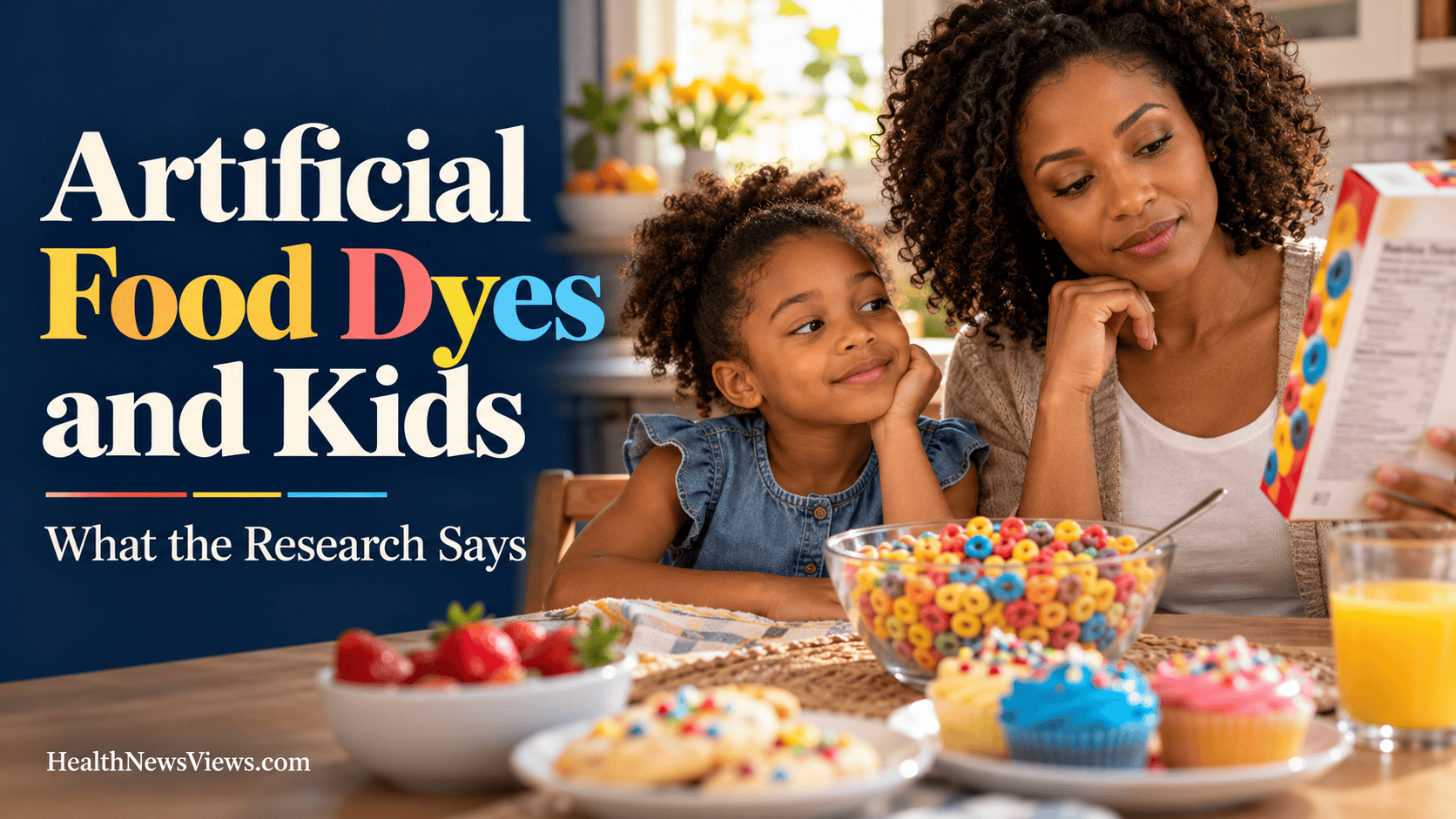
| Featured image alt text | Brightly colored cereal, candy, and drinks on a kitchen table next to a child’s cup |
| Featured image idea | a bowl of colorful cereal next to a bowl of berries; avoid any photo of an identifiable child. |
| Internal links used | /how-to-read-a-nutrition-label/, /what-is-ultra-processed-food/, /food-deserts-and-health-disparities/ |
Open items before publishing
- Lynn: replace the highlighted [LYNN: …] note with 2 to 4 sentences from your own experience, then delete the note.
- Confirm the credentials in the About Lynn box, including whether to list degrees.
- Recommended: have a registered dietitian or physician review the health claims before publishing. No medical reviewer is named in this draft.
- Confirm the internal link slugs above match the live site, and publish the five posts so the cross-links work.
- The regulatory status moves fast (Red No. 3 deadlines, voluntary company pledges). Re-check the FDA pages linked in Sources on the day you publish.