Posted by Lynn | Certified Health Coach and educator | Last reviewed: October 7, 2026 | 7-minute read
| Quick answer: In the baked potato vs potato chips matchup, research suggests the potato is more filling. In one satiety study, boiled potatoes scored 323% against white bread’s 100%, while chips scored 91%. But the baked potato isn’t a free pass. It has a moderately high glycemic index, and toppings change everything. |
Key takeaways
- Same plant, different story: how a potato is cooked and what goes on it changes how filling it is.
- In a classic satiety study, potato chips scored slightly below white bread, and boiled potatoes scored more than three times higher.
- Large studies link chips and fries to more weight gain over time than potatoes in general, but they can’t prove cause.
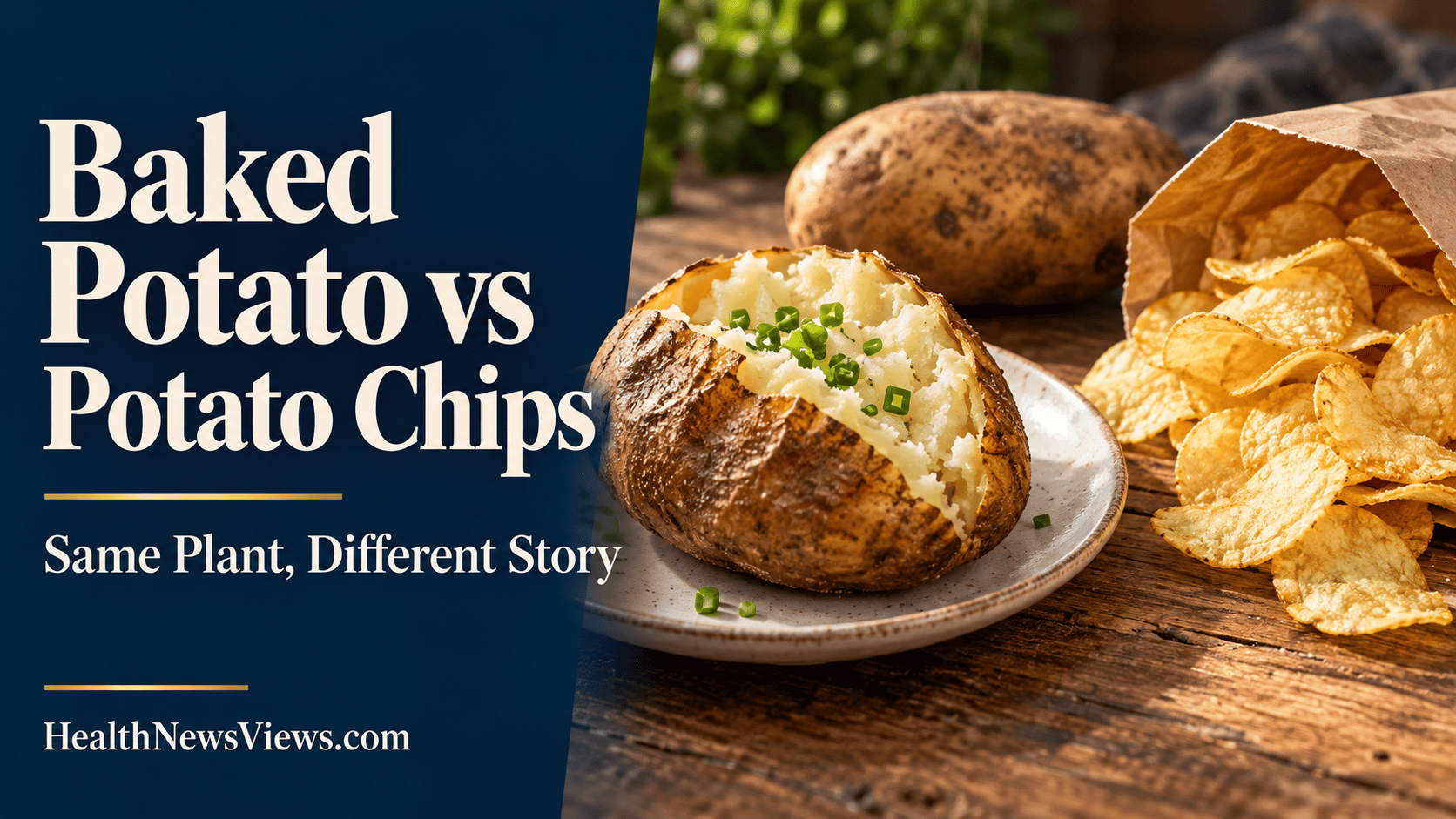
Same plant, different rap sheet. One is a side dish with the skin on. The other is a bag you finished during a TV show. Baked potato vs potato chips sounds like a trick question, but the research gives a fairly clear answer, with a few catches.
I went to the studies so you don’t have to. Some of what I found helps the potato. Some of it doesn’t. You get both.
Where I’m Coming From
I’m not here to put a food on the “bad” list and send you off in shame. I’ve spent more than five years teaching health classes in community churches, and I know the potato is affordable, familiar, and a fixture at many family tables. Telling people to “just avoid potatoes” is not a plan. Knowing what changes a potato is a plan.
In some cultures, the Potato is the meal’s staple, as rice is in others. Boiled, baked, mashed, or fried, for some families that’s the glue that holds the whole meal together. What’s a cookout without potato salad, or mashed potatoes and gravy, at a family gathering? Good, better, best- that is the test. Explanation and instruction can temper a well-meaning discussion about this dietary staple. Showing the benefits of a whole food over a bag of chips is worth the conversation.
The Lineup: Baked Potato vs Potato Chips
A baked potato is a whole vegetable, cooked with heat, usually eaten with the skin on. Potato chips are potatoes that have been sliced thin, fried in oil, seasoned, and bagged. Under the NOVA system, which sorts foods by how much industrial processing they go through, chips typically sit in the ultra-processed group, while a plain baked potato does not. (New to that term? Read What Is Ultra-Processed Food?)
That difference isn’t just a label. It changes the texture, how fast you can eat it, and how much of it fits in your hand.
Which One Keeps You Full? The Satiety Evidence
In 1995, researchers at the University of Sydney fed volunteers 240-calorie portions of 38 different foods and measured how full they felt over the next two hours. White bread was the reference food, set at 100%. Boiled potatoes scored 323%, the highest of any food tested. Potato crisps (what Americans call chips) scored 91%, a little below white bread. French fries scored 116% (Holt et al., European Journal of Clinical Nutrition, 1995).
In the baked potato vs potato chips matchup, that’s a point for the potato. Two honest notes. First, that study tested boiled potatoes, not baked, so I can’t tell you a baked potato scored 323%. Second, it’s a 30-year-old study with a short follow-up. What it does show is that the same plant can sit at the top of the fullness chart or near the bottom, depending on how it’s prepared.
That matches what many of us have felt: you can finish a bag of chips and still feel like something is missing. It’s hard to say that about a plain potato.
What About Blood Sugar? The Glycemic Index Problem
Here’s where the potato’s defense gets weaker. The glycemic index (GI) ranks foods by how much they raise blood sugar compared with a reference food. In a study by Fernandes, Velangi and Wolever, a baked U.S. Russet potato had a GI of 77. Boiled red potatoes came in at 89, and instant mashed potatoes at 88. The authors described U.S. Russet potatoes as having “only a moderately high glycemic index” (Journal of the American Dietetic Association, 2005).
The same study found something useful: boiled red potatoes that were cooked ahead and eaten cold had a GI of 56. Precooking and then eating cold or reheated potatoes lowered the blood sugar response in the study. If you live with diabetes or prediabetes, this is a conversation for your doctor or a registered dietitian, since a single food’s GI doesn’t tell the whole story of a meal.
What About Weight Over Time?
Now for the long view. A well-known study in the New England Journal of Medicine followed 120,877 U.S. health professionals for 4-year periods and looked at how changes in food choices related to weight changes. For each extra daily serving, potato chips were linked to about 1.69 pounds of additional weight gain over four years, French fries to about 3.35 pounds, and potatoes (boiled, baked, or mashed) to about 1.28 pounds (Mozaffarian et al., NEJM, June 2011).
Notice what that says: potatoes weren’t off the hook. But French fries and chips were linked to more weight gain than potatoes cooked other ways. This was observational research, so it can’t prove that the food caused the weight gain. People who eat a lot of chips may differ in other ways, too. The honest summary is a pattern, not a proof.
The Toppings Problem
This is where baked potatoes often lose the baked potato vs potato chips fight, and it has nothing to do with the potato. A plain baked potato and a loaded baked potato are two different foods. Heaps of butter, sour cream, cheese, and bacon change the story.
Same detective logic applies to chips. Flavored varieties add seasonings and sometimes colors, which is a separate conversation (see Artificial Food Dyes and Kids). And the back-of-bag label tells you the serving size, which is usually smaller than the bag. If you need a refresher, the 60-second label guide will get you there.
And one more thing, because this isn’t just about willpower. What’s sold in your neighborhood, how much time you have, and what your budget allows all shape which potato ends up on the plate. That’s structural. (Read more in Food Deserts and Health Disparities.)
So What Now? Your Do-This-Week Steps
The baked potato vs potato chips question has a practical answer: it depends on the cooking and the toppings.
- Keep the skin on. A baked potato with the skin is a whole food with fiber, and it’s simple to make.
- Top it smart. Try plain yogurt, salsa, beans, or steamed vegetables in place of piles of butter and cheese.
- Try cook-ahead. If blood sugar is a concern for you, ask your doctor about cooling and reheating potatoes, since that lowered the glycemic response in one study.
- Portion the chips. If chips are your thing, put a serving in a bowl instead of eating from the bag.
Frequently Asked Questions
Baked potato vs potato chips: which is healthier?
A plain baked potato is a whole food and, in satiety research, potatoes scored far higher for fullness than chips. But toppings, portion size, and your own health needs matter. A loaded potato can look very different from a plain one.
What is the glycemic index of a baked potato?
In a 2005 study, a baked U.S. Russet potato had a glycemic index of 77, which the authors described as moderately high. Boiled red potatoes cooked ahead and eaten cold scored 56.
Do potato chips make you gain weight?
A large study of more than 120,000 people linked each extra daily serving of potato chips to about 1.69 pounds of weight gain over four years. Because it was observational, it shows a pattern, not proof of cause.
Which food is more filling, potatoes or chips?
In a 1995 satiety study, boiled potatoes scored 323% against white bread at 100%, while potato crisps scored 91%. That study tested boiled potatoes, not baked.
Are french fries worse than baked potatoes?
In the NEJM study, each daily serving of French fries was linked to about 3.35 pounds of weight gain over four years, versus about 1.28 pounds for potatoes cooked other ways. This was an observational finding and cannot prove cause.
This article is for educational purposes only and is not a substitute for medical advice. I’m an educator and health coach, not a physician. Your doctor or a registered dietitian knows your numbers, your history, and your body. Talk to them before making changes based on anything you read here. The choice is yours.
I’m just sayin’.
Sources and Further Reading
- Holt SH, Miller JC, Petocz P, Farmakalidis E. “A satiety index of common foods.” European Journal of Clinical Nutrition, 1995.
- Fernandes G, Velangi A, Wolever TMS. “Glycemic index of potatoes commonly consumed in North America.” Journal of the American Dietetic Association, 2005.
- Mozaffarian D, Hao T, Rimm EB, Willett WC, Hu FB. “Changes in diet and lifestyle and long-term weight gain in women and men.” New England Journal of Medicine, June 2011.
Want the Whole Case File?
Food: The Final Frontier goes deeper on exactly this: what’s really in our food, how it connects to the chronic disease numbers we keep watching climb, and what you can do about it, in plain English. Get it at foodthefinalfrontier.com or on Amazon.
About Lynn
Lynn Peterson is a certified health coach, educator, and the author of Food: The Final Frontier. She has taught more than 3,000 allied health students, led community health classes in churches for more than five years, and hosts the Health News & Views podcast, with more than 140 episodes. She is not a physician. She reads the research, explains it plainly, and sends you back to your own doctor for the personal call. Her mission is clear, trustworthy health information for the communities that mainstream sources too often overlook.