Originally published: March 22, 2019 | Updated: February 2026
Blog — I’m Just Sayin’ Nutrition | Posted by Lynn
Artificial food dyes are everywhere—from candy to cereal—but what are they really doing to our bodies?
Oh, I like the red one. No, give me the green one — I’ll have the pink one, and I’ll have the blue one. They are all so beautifully decorated, and the children will love these!
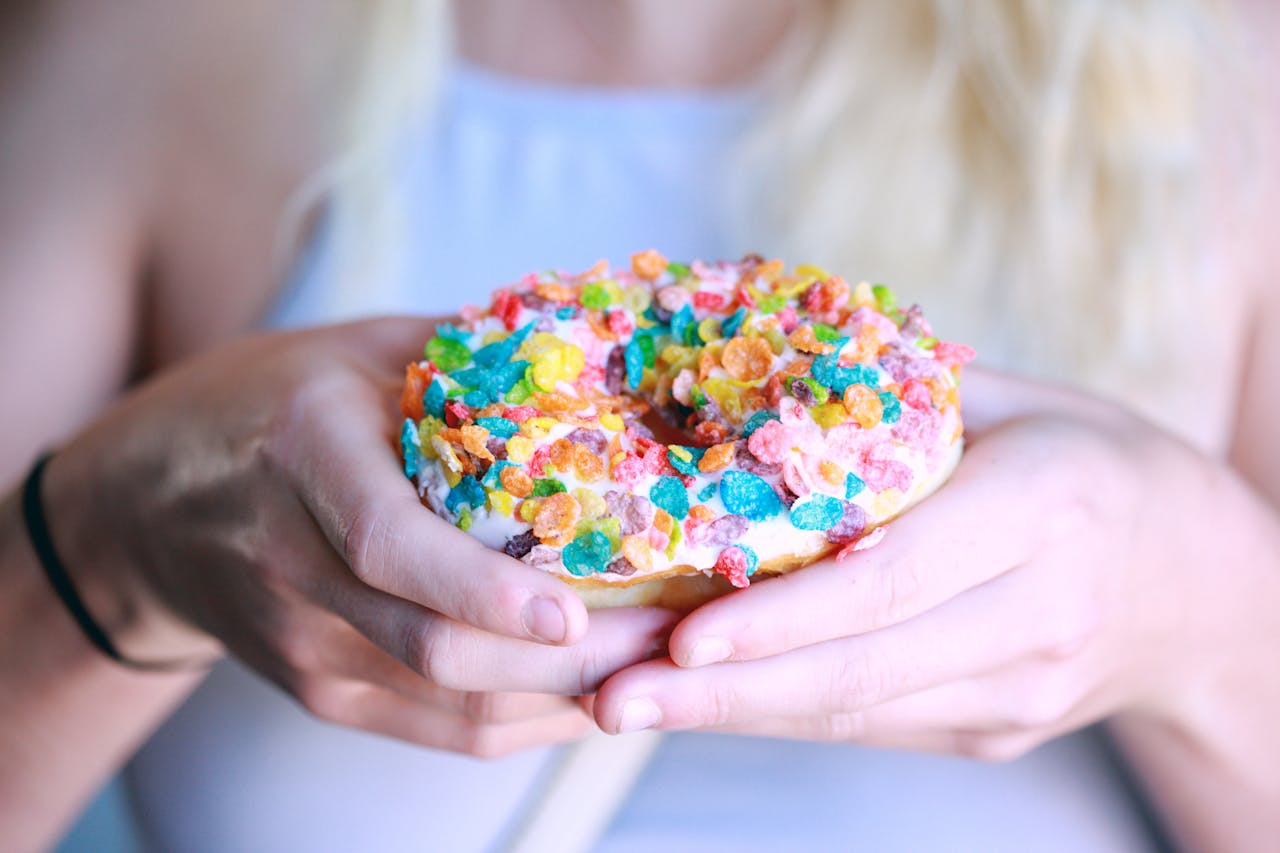
Colored candy, cereal, cupcakes, and water ice (a Philly thing) lure us in with child-like anticipation. As humans, we are drawn to color. The more brilliant, the more irresistible. Color affects our mood and motivation, our sense of warmth or energy, even our appetite. Blues feel calming. Reds and oranges feel exciting. Green evokes nature and health. This isn’t just poetry — it’s psychology, and the food industry has known it and used it for decades.
But my question has always been: What is the health impact on the human body? How much testing was done to determine the long-term effects of dyes that are constantly ingested — especially by children, who are the biggest consumers? Are we poisoning ourselves? And what are the alternatives?
Food Coloring or Food Poison?

When I first wrote this piece in 2019, these were questions many parents and researchers were raising but regulatory agencies were largely dismissing. A lot has changed since then.
According to Healthline, consumption of artificial food dyes increased by 500% over the 50 years leading up to this decade, with children as the primary consumers. Food dyes are chemical substances made to enhance the appearance of food by giving it artificial color — and today they are made from petroleum.
The first artificial food colorings were developed in 1856 from coal tar. Hundreds have been created over the decades. Most have since been found to be toxic and removed from use. The purple dye once used by the USDA to stamp meat? Poisonous — and eventually banned. What remains is a small handful of synthetic dyes still widely used in our food, our beverages, our cereals, our medications — and even our children’s toothpaste.
What the Regulatory Agencies Said — and What’s Changed
For years, the U.S. Food and Drug Administration (FDA) and the European Food Safety Authority (EFSA) maintained that approved dyes did not pose significant health risks, based on animal toxicity studies conducted at the time of approval. That position is now shifting in significant ways.
In January 2025, the FDA banned Red Dye No. 3 (Erythrosine) from food and ingested drugs due to its link to thyroid tumors in laboratory studies — a finding that had been documented since the 1980s.
Then, in April 2025, the FDA announced a sweeping plan to phase out all petroleum-based synthetic dyes from the U.S. food supply. According to the FDA announcement, the plan includes:
- Establishing a national timeline for the food industry to transition to natural color alternatives
- Revoking authorization for Citrus Red No. 2 and Orange B
- Working with the food industry to eliminate six remaining synthetic dyes — Green No. 3, Red No. 40, Yellow No. 5, Yellow No. 6, Blue No. 1, and Blue No. 2 — from the food supply
- Authorizing new natural color additives as replacements
- Partnering with the National Institutes of Health (NIH) to research how food additives impact children’s health and development
For those of us who have been raising these concerns for years: the science is catching up with the conversation.
The Dyes Still in Use — And Their Known Concerns
The following information draws from multiple sources, including the original infographic from Special-Education-Degree.net, Healthline’s food dye review (updated January 2026), and peer-reviewed studies. These are the synthetic dyes currently or recently approved for use in U.S. food:
Red No. 3 (Erythrosine) — Commonly found in baked goods, candy, sausage, and maraschino cherries. Linked to thyroid tumors in animal studies. The FDA issued a partial ban in 1990 and a full ban in January 2025.
Red No. 40 (Allura Red) — The most widely used food dye in the U.S., present in roughly 14% of all products sold by top manufacturers as of a 2025 study. Found in sports drinks, candy, cereal, condiments, and cosmetics. Research has found a suspected link to immune system effects and hyperactivity in some children.
Yellow No. 5 (Tartrazine) — Found in candy, soft drinks, chips, cereals, and baked goods. May cause allergy-like reactions and mild to severe hypersensitivity in some individuals, particularly those with aspirin sensitivity.
Yellow No. 6 (Sunset Yellow) — Found in baked goods, sausage, cereal, sauces, and cosmetics. Animal studies have found a link to adrenal gland tumors. May contribute to hyperactivity in some children.
Blue No. 1 (Brilliant Blue) — Found in baked goods, beverages, candy, cereal, ice cream, and packaged soups. Associated with kidney tumors in mice; may trigger allergic reactions in individuals with pre-existing asthma. A 2022 peer-reviewed study found an association with ADHD symptoms in children.
Blue No. 2 (Indigo Carmine) — Found in beverages, candy, dog food, cereal, and ice cream. Animal studies have observed a significant occurrence of brain gliomas in male rats.
Green No. 3 (Fast Green) — Found in beverages, candy, ice cream, and cosmetics. Approved by the FDA but prohibited in the EU. Animal studies found significant increases in bladder tumors in male rats.
Citrus Red No. 2 — Found in the skin of Florida oranges (to enhance color). Classified as “possibly carcinogenic to humans” by the International Agency for Research on Cancer (IARC). FDA revocation of its authorization is in progress.
Please note: The presence of a dye on this list does not mean every person consuming it will experience harm. Individual sensitivity varies significantly, and the science in this area is evolving. If you have health concerns, consult your physician before making dietary changes.
Dr. Rebecca Bevans: The Voice That Got Ahead of the Science
When I first included Dr. Rebecca Bevans in this article in 2019, she was a relatively under-the-radar researcher whose TEDx talk had been gaining quiet traction. Since then, her work has reached a global audience.
Dr. Bevans, Ph.D., is a professor of psychology at Western Nevada College. She holds a doctorate in Cognitive Neuroscience and a master’s degree in Human Development from the University of Nevada, Reno. She is also the president of Brain Matterz, a Nevada nonprofit focused on brain disorder research and education.
Her TEDxCarsonCity talk, “The Effects of Artificial Food Dyes”, now has nearly 500,000 YouTube views, and her story has been featured in Forbes, KQED, and a 2025 documentary, To Dye For, available on Prime Video, Apple TV, Vimeo, and Fandango. In 2025, she co-authored a book — Everything You Need to Know About Synthetic Food Dyes — synthesizing more than 170 scientific studies on the topic.
Her initial research, and what made the TEDx talk so compelling, was intensely personal. Her son Alex was seven years old when he looked at her and asked for a knife — saying he didn’t want to live like that anymore. The family doctor had no answers. Dr. Bevans, armed with her background in cognitive neuroscience, turned to the research — and eventually traced the source: synthetic food dyes.
In her talk, she describes the behavioral patterns she documented in her son for each dye color:
- Red — Hyperactivity, migraines, impulsiveness, “brain buzzing.” Similar to ADHD symptoms. Effects last 1–2 days.
- Green — Mania, hyperactivity, a feeling of euphoria. Similar to bipolar symptoms. Effects last approximately 12 hours.
- Yellow — Defiant behavior, violent outbursts, aggression, anxiety, suicidal ideation. Similar to Oppositional Defiant Disorder and Conduct Disorder. Effects can last up to five days.
- Blue — Irritability, moodiness, fatigue. Effects last approximately 24 hours.
Dr. Bevans is careful to note that not all children respond to dyes in the same way — and the peer-reviewed research supports this nuance. A 2022 review published in Environmental Health found that food dyes may be associated with changes to attention and activity in children, and a separate 2022 review found a specific association between Blue No. 1 and Blue No. 2 and ADHD symptoms. The American Academy of Pediatrics stated in a 2018 policy statement that artificial food colors “may be associated with exacerbation of ADHD symptoms.”
None of this is settled science. But it is accumulating science — and the FDA’s 2025 phase-out announcement suggests that the regulatory tide is turning.
So What Do We Do Now?
Unless a product’s label clearly states that its colors are derived from plant-based sources, it is reasonable to assume they are artificial. And it’s worth noting: the same applies to many medications. An estimated 80–90% of medicines contain food dyes.
The most practical steps remain the same ones I suggested in 2019:
- Read labels. If you see a color listed by number (Red 40, Yellow 5, Blue 1), it is artificial and petroleum-based.
- Choose whole foods. The biggest sources of artificial dyes are ultra-processed foods that carry other health concerns anyway. Eliminating them addresses multiple problems at once.
- Look for natural alternatives. Beets and raspberries make beautiful pink smoothies. Turmeric gives a golden yellow. Companies can and do make petroleum-free color options — the demand is growing.
- Check your medications. If your child is taking a prescription, ask your pharmacist whether the formulation contains synthetic dyes and whether a dye-free version is available.
- Talk to your doctor. If your child shows signs of hyperactivity, behavioral changes, or sensitivity reactions, bring it up with their pediatrician. The conversation around food dyes and children’s neurobehavioral health is now mainstream enough to warrant a direct discussion.
The choice is ultimately ours. Reds, greens, yellows, oranges, purples, blues — those are the colors of the rainbow. Nature gave us an extraordinary array of whole foods already bursting with them. Let’s begin to make the choices we know are better for our health and our families.
I’m just sayin’.
Watch, Read & Learn
🎬 Dr. Rebecca Bevans — TEDxCarsonCity: The Effects of Artificial Food Dyes (YouTube)
🎥 Documentary: To Dye For — Available on Prime Video, Apple TV, Vimeo, and Fandango
📖 Book: Everything You Need to Know About Synthetic Food Dyes — Dr. Rebecca Bevans & Dr. Lorne Hofseth (2025)
Sources & Further Reading
- FDA — HHS Announcement: Phase-Out of Petroleum-Based Synthetic Dyes (April 2025): fda.gov
- FDA — Red No. 3 Ban (January 2025): fda.gov
- Healthline — Food Dyes: Harmless or Harmful? (Updated January 2026): healthline.com
- Special-Education-Degree.net — “Colors to Die For: The Dangerous Impact of Food Coloring” (Infographic): special-education-degree.net
- Western Nevada College — Dr. Bevans Feature (2025): wnc.edu
- KQED — “What You Need to Know About the Food Dye in Holiday Treats”: kqed.org
- WebMD — ADHD and Food Additives: webmd.com
This article is intended for general educational and informational purposes only and does not constitute medical advice. If you have specific concerns about food sensitivities, allergies, or your child’s behavior, please consult a qualified healthcare professional.