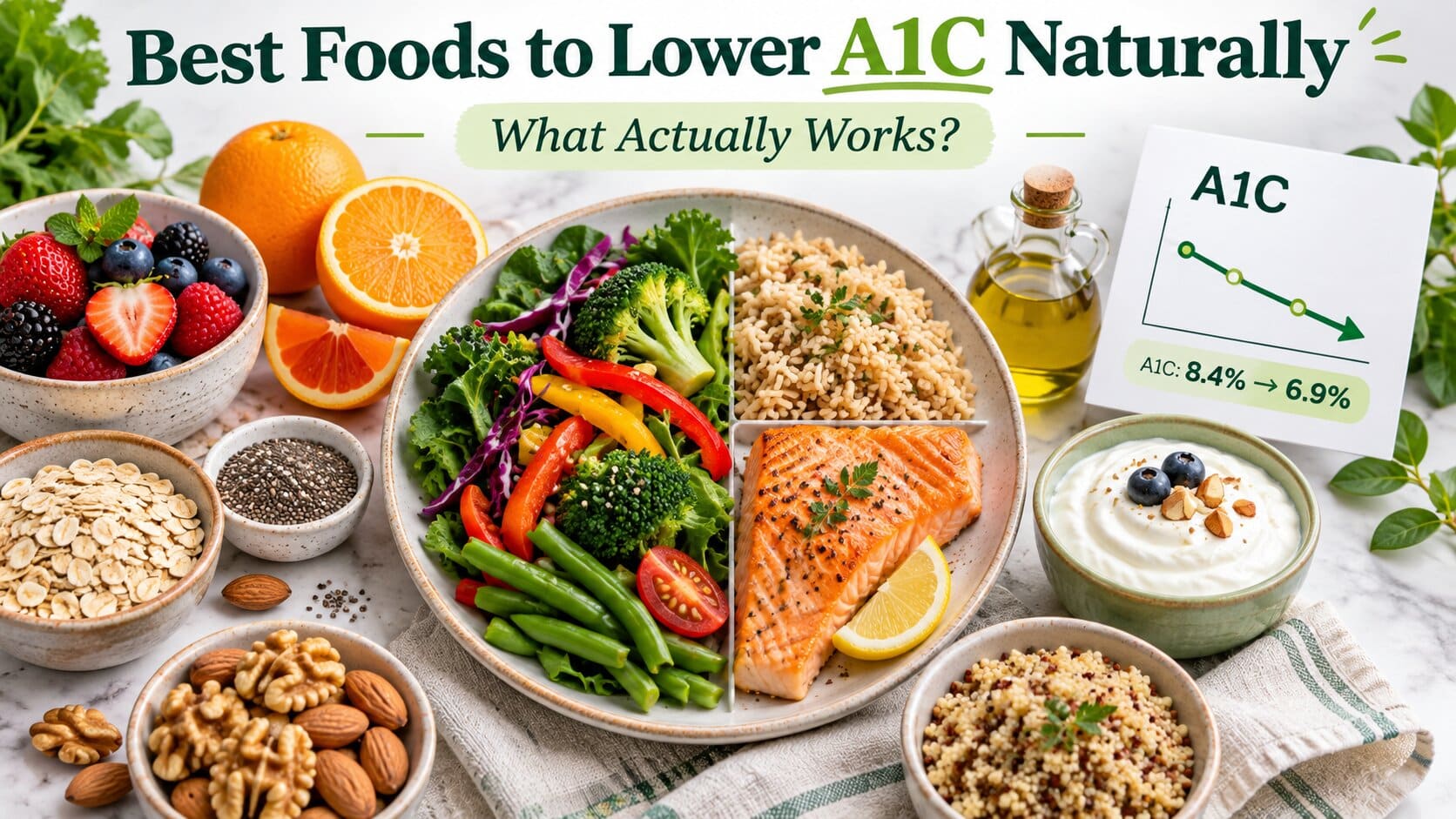
I spent more than a decade in front of a classroom, so let me put this in terms I know well: your A1C is a report card.
Not a pop quiz. Not a single bad day. A report card, covering about three months of work. And like any report card, you can’t cram the night before and expect a miracle. But you can change what goes on the next one.
If you’re wondering which are the best foods to lower A1C, the research points to everyday staples like beans, leafy greens, whole grains, and healthy fats—not miracle supplements or expensive superfoods.
Where I’m coming from
My sister was an emergency room nurse. She spent her career saving other people’s lives, and she died nine years ago from complications of type 2 diabetes. When I asked her why she hadn’t known about the connection between food and sickness, she told me, “I was taught Medicine, not nutrition.” I’m one of seven children, and three of us live with type 2 diabetes. That’s why I read the research, and that’s why I’m writing this.
This topic matters to our community in a big way. According to the CDC’s National Diabetes Statistics Report, about 12.1% of non-Hispanic Black adults have diagnosed diabetes, one of the highest rates of any group in the country. That isn’t about willpower. It’s structural: food deserts, cheap refined carbohydrates on every corner, and sugary drinks marketed straight at our neighborhoods. We are developing and dying from preventable, chronic diseases. It doesn’t have to be that way.
First, what is A1C, anyway?
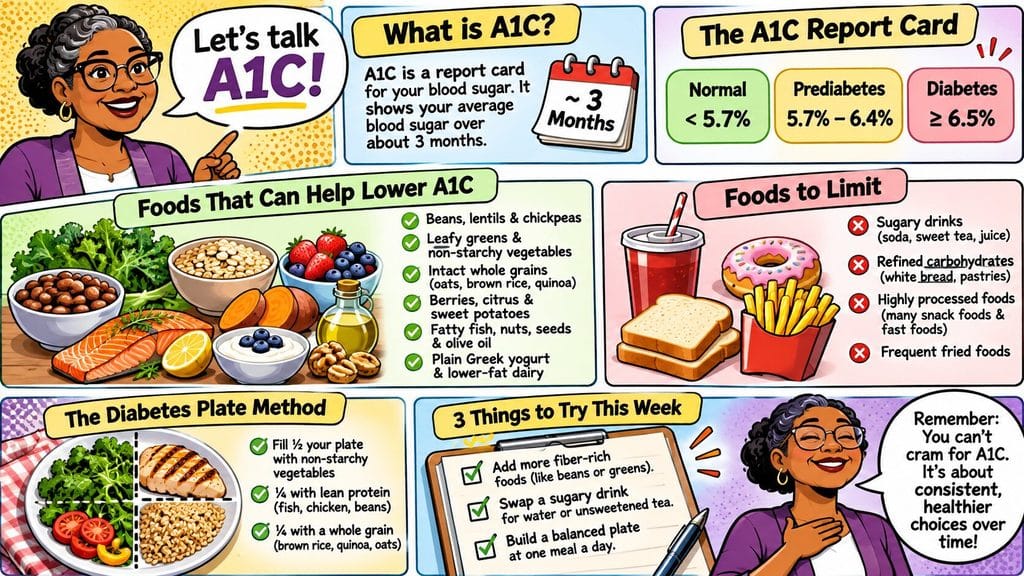
When sugar enters your bloodstream, it attaches to hemoglobin (the oxygen-carrying protein in your red blood cells). The A1C test measures what percentage of your hemoglobin is “sugar-coated.” Because red blood cells live about three months, the CDC explains, A1C gives a picture of your average blood sugar over that window.
Here’s how the CDC reads the report card:
- Normal: below 5.7%
- Prediabetes: 5.7% to 6.4%
- Diabetes: 6.5% or higher
For most people living with diabetes, the CDC notes the goal is 7% or less, though your doctor sets your personal target.
Now the hopeful part. In the landmark Diabetes Prevention Program, people with prediabetes who made structured lifestyle changes (eating differently, moving more, and losing a modest amount of weight) cut their risk of developing type 2 diabetes by 58%, and by 71% for those over 60. Food is not the whole story. But it’s a big chapter.
The best foods to lower A1C: the honor roll
The American Diabetes Association calls its top picks “superstar foods”: nutrient-dense options that help manage blood glucose. Here’s my honor roll, with the evidence behind each.
1. Beans, lentils, and chickpeas
If I had to pick a valedictorian, it would be the humble bean. The ADA calls beans, dried peas, and legumes plant-based protein superstars, packed with fiber, folate, potassium, iron, and zinc.
The research backs it up. In a 2012 randomized trial in Archives of Internal Medicine, Dr. David Jenkins of the University of Toronto had 121 people with type 2 diabetes eat about 1 cup of legumes a day for three months. Their A1C dropped by 0.5%, compared with 0.3% in a group eating more whole-wheat fiber. Jenkins noted that a drop of 0.3% to 0.4% is considered meaningful.
In the spirit of following the money: that study was partly funded by a pulse growers’ association, and an accompanying commentary by dietitian Marion Franz asked how many people can keep up a cup of beans every day. Fair question. Start with half a cup and build from there.
2. Dark leafy greens and non-starchy vegetables
Collards, kale, spinach, cabbage, green beans, broccoli, peppers, okra. The ADA’s Diabetes Plate Method recommends filling half your plate with non-starchy vegetables because they’re low in carbohydrates and high in fiber, vitamins, and minerals, so they don’t raise blood glucose much. Your grandmother’s greens were onto something. Just go easy on the salt pork.
3. Intact whole grains
Oats, barley, brown rice, quinoa, farro. Harvard Health Publishing points out that foods made from 100% whole-grain flour are okay, but intact whole grains are even better.
Why? Fiber. A 2020 review in PLOS Medicine led by Dr. Andrew Reynolds of New Zealand’s University of Otago pooled 33 trials and found that increasing fiber lowered A1C in adults with diabetes and prediabetes. The authors suggested aiming for about 35 grams of fiber a day. The same research group also found that heavy processing can strip away some of those benefits. It’s not the carb, it’s the processing.
4. Berries, citrus, and sweet potatoes
Yes, you can eat fruit. The ADA counts berries among its superstar carbohydrate foods and suggests pairing them with plain Greek yogurt and walnuts for breakfast. Citrus fruits like oranges and grapefruit bring fiber and vitamin C. And according to the ADA, sweet potatoes have a lower glycemic index (a measure of how quickly a food raises blood sugar) than regular white potatoes.
The key word is whole. Harvard Health lists fruit juice right alongside soda as a sugary drink to limit.
5. Fatty fish, nuts, seeds, and olive oil
Salmon, sardines, mackerel, walnuts, almonds, chia seeds, extra virgin olive oil. These are the backbone of the Mediterranean diet, and the evidence for it keeps growing. A December 2025 meta-analysis of randomized controlled trials in the journal Nutrients found the Mediterranean diet lowered A1C by about 0.47% in people with type 2 diabetes. The ADA does have one tip: roast and season your own nuts to avoid the added sodium in store-bought versions.
6. Plain Greek yogurt and low-fat dairy
Harvard Health includes plain Greek yogurt, low-fat milk, and cottage cheese on its list of prediabetes-friendly foods. The word plain is doing a lot of work there. Flavored yogurts can carry as much sugar as dessert, so read the label.
Is there one best diet? Not exactly.
Like most things in nutrition, the truth is more nuanced than the headlines suggest. A 2018 network meta-analysis led by Lukas Schwingshackl in the European Journal of Epidemiology compared several eating patterns for people with type 2 diabetes. Low-carb, Mediterranean, Paleo, vegetarian, low-glycemic, and high-protein approaches all lowered A1C compared with a control diet, by roughly 0.5% to 0.8%. Low-carb ranked first and the Mediterranean a close second.
What do the winners have in common? More vegetables, beans, and whole foods; fewer refined carbohydrates and sugary drinks. Bio-individuality matters. The best eating pattern is the one built on whole foods that you can actually stick with.
Foods that work against you
Harvard Health’s prediabetes diet guidance says no foods are completely off-limits, but these are the ones to limit:
- Sugary drinks: soda, fruit juice, sweet tea, sweetened coffee drinks, sports drinks, and energy drinks
- Refined carbohydrates: white bread, white pasta, white rice, and white tortillas
- Fast food and fried food
- Alcohol
Notice a pattern? Most of these are ultra-processed, cheap, and everywhere. Again, structural, not personal.
Putting it on your plate
You don’t need a calculator. The ADA’s Diabetes Plate Method keeps it simple. Start with a 9-inch plate, then:
- Fill half with non-starchy vegetables (greens, broccoli, peppers, tomatoes)
- Fill a quarter with lean protein (fish, chicken, beans, eggs, tofu)
- Fill a quarter with quality carbohydrates (brown rice, sweet potato, whole fruit)
- Drink water or another zero-calorie beverage
One heads-up from the ADA: beans and lentils count as both protein and carbohydrate, so adjust the carb portion when you use them.
So what now? Three things to try this week
- Add one cup of beans to your week: black beans in a salad, lentil soup, or chickpeas roasted with spices.
- Swap one sugary drink a day for water, seltzer with lime, or unsweetened tea.
- Build one dinner on the plate method, with half the plate vegetables.
Then give it time. Remember, your A1C reflects about three months, so don’t judge your progress by one week. Ask your doctor when to retest, and if you have prediabetes, ask whether a CDC-recognized National Diabetes Prevention Program is offered near you, in person or online.
Your body is a marvelous work, and it responds when you give it better materials. The choice is yours. Food really is the final frontier.
I’m just sayin’.
How long does it take to lower A1C with diet?
Your A1C reflects your average blood sugar over roughly the past three months, so meaningful changes take time. Eating more fiber-rich foods, cutting back on sugary drinks, and choosing balanced meals can help improve blood sugar management. Many people have their A1C rechecked after about three months, but your healthcare provider can recommend the right schedule for you. Remember, this is a report card, not a pop quiz.
Can you eat fruit if you have diabetes or high A1C?
Absolutely. Having diabetes doesn’t mean fruit is off the menu. Whole fruits like berries, oranges, and apples provide fiber, vitamins, and other nutrients. The key is paying attention to portions and choosing whole fruit more often than juice. Pairing fruit with protein or healthy fats, such as plain Greek yogurt or walnuts, can also help create a more balanced snack.
Is there one food that lowers A1C quickly?
No single food can reliably lower A1C overnight, no matter what the miracle-food headlines promise. Research supports eating patterns that include beans, lentils, non-starchy vegetables, whole grains, and healthy fats. Consistency matters more than any one ingredient. Think of it this way: you don’t earn an A on your report card with one good homework assignment. It’s the work you do over time that counts.
Sources & Further Reading
- Centers for Disease Control and Prevention. A1C Test for Diabetes and Prediabetes
- Centers for Disease Control and Prevention. National Diabetes Statistics Report
- Centers for Disease Control and Prevention. About the National Diabetes Prevention Program
- NIDDK. Diabetes Prevention Program (DPP)
- American Diabetes Association. What Superstar Foods Are Good for Diabetes?
- American Diabetes Association. What Is the Diabetes Plate?
- Jenkins, D. et al. (2012). Effect of legumes as part of a low glycemic index diet on glycemic control. Archives of Internal Medicine. JAMA Network release · WebMD/CBS coverage
- Reynolds, A. et al. (2020). Dietary fibre and whole grains in diabetes management. PLOS Medicine
- University of Otago (2020). Higher fiber saves lives, but food processing may remove benefits
- (2025). Impact of the Mediterranean Diet on Glycemic Control in Type 2 Diabetes: A Meta-Analysis of RCTs. Nutrients
- Schwingshackl, L. et al. (2018). A network meta-analysis on the comparative efficacy of different dietary approaches on glycaemic control. European Journal of Epidemiology
- Harvard Health Publishing. Prediabetes diet: How to help prevent progression to diabetes
- Harvard Health Publishing. Healthy lifestyle can prevent diabetes (and even reverse it)
- St. Joseph’s/Candler, citing the ADA. Ten superfoods people with diabetes should incorporate (sweet potato glycemic index)
About Lynn
Lynn Peterson (B.A., M.S., D.Sc., Certified Health Coach) is an instructor, writer, researcher, and the voice behind Health News & Views and the podcast Food: The Final Frontier. With more than a decade of post-secondary teaching in human anatomy, medical terminology, and health education, she reads the studies so you don’t have to. She’s just the messenger: her mission is to take the mystery out of medicine.